Infrastructures for Voice
Extract of an article that offers a series of provocations that framed the research residencies at the beginning of the project The City Talks Back. Each is an ideas to think with and about different configurations of voices, spaces, and technologies. Each one is a possibility – a structure of communication, that links the different works together whilst serving as a strategy or as a warning. They are all intended as invitations to read further, to put into action, or to question who is (and isn’t) heard in the city and how the audibility of voices changes across the city’s varying spaces.
We speak. Whether with our voices, our hands or through technologies, speaking is inseparable from being human. When do our words become political? Politics can be in what we say, but it can also be in the places and ways in which we speak. If the same words are delivered from a pulpit or over a kitchen sink, they don’t carry the same meaning. Cities have speech too – they translate what we say via their own language, each having a unique syntax made up of its particular configurations of spaces, cultures, infrastructures, and technologies. So, what kinds of spaces make our words political? Who has access to them? And how do those excluded from those spaces find ways to amplify their voices?
Provocation 1. Urban configurations as infrastructures for protest
Cities can emerge from collective life and engender collective politics and ownership. But they can also be (re)planned from the top down, making them easier to control. In this sense, we can think of the configuration of cities like an infrastructure for political voice, that can be manipulated to make it easier or harder to be heard.
According to economic geographer David Harvey, it is clear that: “certain urban environmental characteristics are more conducive to rebellious protest than others – such as the centrality of squares like Tahrir, Tiananmen, and Syntagma, the more easily barricaded streets of Paris compared to London or Los Angeles, or El Alto’s position commanding the main supply routes into La Paz. At the same time, reconfiguring cities and their public spaces, framed often as a question of public health, can also be an act of control of urban populations. This was most famously the case with Haussmann’s boulevards in Paris, which were viewed even at the time as a means of military control of rebellious citizens. This case is not unique. The re-engineering of inner cities in the United States in the wake of the urban uprisings of the 1960s just happened to create major physical highway barriers – moats, in effect – between citadels of high-value downtown property and impoverished inner-city neighbourhoods. The violent struggles that occurred in the drive to subdue oppositional movements in Ramallah on the West Bank (pursued by the Israeli IDF) and Fallujah in Iraq (pursued by the US military) have played a crucial role in forcing a re-think of military strategies to pacify, police, and control urban populations. […] The urban obviously functions, then, as an important site of political action and revolt. The actual site characteristics are important, and the physical and social re-engineering and territorial organization of these sites is a weapon in political struggles”.
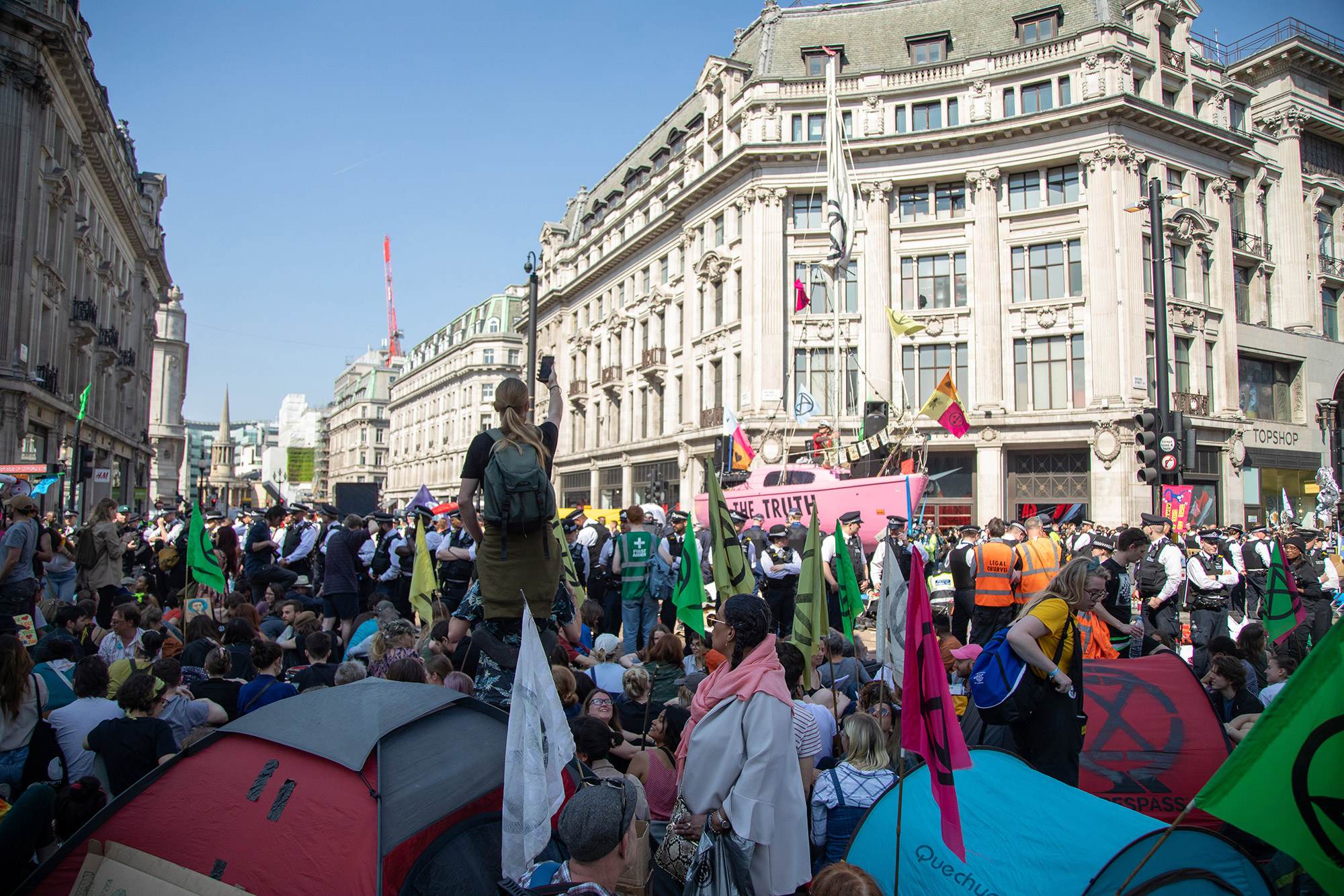
Similar spatial strategies have also been adopted by urban populations and demonstrators. Learning the characteristics of the city, and appropriating them to their benefit, is one way for citizens to multiply the impact of their protest. In London, rallies traditionally march from Parliament Square to Trafalgar Square along Piccadilly. These are the symbolic spaces of political representation in the city, with a long history of protest. They are, however, not necessarily crucial to transport in the city. Huge numbers of people are needed to fill them and leaving them half empty only risks proving the lack of support for a cause. In 2018, Extinction Rebellion took a different approach. With a small number of people, they blocked Waterloo Bridge and Oxford Circus, key points in the traffic network of the city, or what we can call ‘instrumental spaces’ – being more ‘useful’ than ‘symbolically meaningful’. Their presence rippled through the city, affecting traffic for miles around. A gathering of 100 had more practical impact on the city than a parade of 100,000 on Piccadilly. They had to be listened to. Even more dramatically, in 2018, a single drone flown by an unknown operator caused the shutdown of Gatwick Airport in London, stopping hundreds of flights. It was speculated that this might also be an environmental protest but it turned out to be a local couple with no apparent motive. Either way, they showed how an individual can amplify their actions by aiming them at new infrastructural centralities. Does protest need to learn the changing configurations of the built environment to be heard? Does it need to leave behind or upgrade its traditions, and focus on the new infrastructural connections that really keep cities moving?
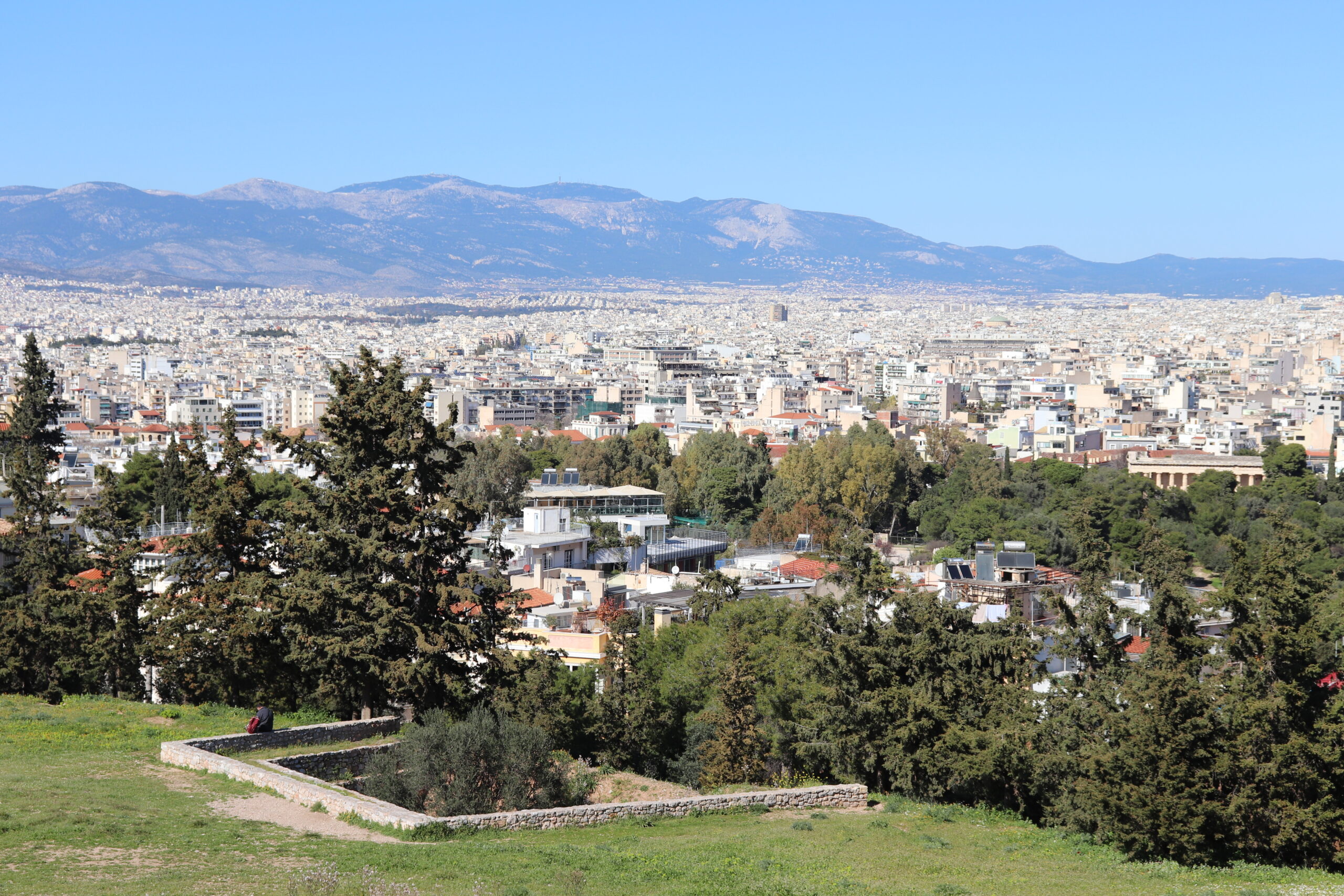
In his ‘The City Talks Back’ contribution ‘Παγκόσμια Ηχώ | Echos-Monde | The World is Echo’, activist and ethnomusicologist Tom Western investigated Athens’ Omonoia square as a circular focal point, a central node that works as a swirl of Athenian life, gathering and then redistributing long histories of movement, encounter, exchange, and dissent – “όλη η Αθήνα βρίσκεται στην Oμόνοια μέσα” [Omonoia contains all of Athens], as Nicolas Calas wrote in 1933. This was tangibly linked to Tim Ward’s ‘Route One’ piece, which traced a journey through the Athens suburbs in the times of lockdown, when free movement in the city was halted and suburban dwellers were cut off from the crowded voices of central neighbourhoods. How do configurations of voice vary from centre to edge?
Provocation 2. Communicative configurations for protest and occupation
Whilst protests are public performances that reproduce already-rehearsed ideas, occupations are more self-contained: collectively-produced commons that work to generate new politics. To explain further, a protest could be described as an exclamation; a performance directed outwards to an attending crowd. The ground it takes place on is used as a temporary stage whose value lies in the visibility of its location to the public. Occupation, on the other hand, attempts to enact a new reality, to claim ownership over its ground. It directly defies law to claim that ‘we’ can gather ‘here’ in ‘this space’ for ‘a period of time’. By occupying a space, the ground itself – who owns it, what it can be used for, for how long – is foregrounded and contested. The persistence of different groups and their improvised dynamics on the same ground make occupations visible; yet, they are turned inwards, around deliberation and the development of new shared (or conflicted) ideas.
In scenes from an occupation, writer Eli Schmitt and filmmaker Astra Taylor provide a vivid image of the different reality of occupation in relation to protest. Schmitt relates that: “The group had congregated at Zuccotti Park, at Liberty Plaza, a paved rectangle between Broadway and Trinity Place, and looked to be at least a few hundred strong. Instead of a single, unified congregation, there were smaller circles of ten to fifty people, some with megaphones. Some circles had moderators and agendas, others appeared to be more spontaneous”. But then, Taylor remembers that, once the crowd was dispersed: “I followed an impromptu procession into the park where they are now encamped. I hooked up with a group of friends and we had an ‘assembly’ with a bunch of strangers and talked economics for two or three hours. It was kind of nice to be at a protest and, instead of marching and shouting, to be talking about ideas”.
Human configurations as infrastructures for political voice are vital not only in the way they occupy space in cities – i.e. smaller circles or unified congregations – but also in the means they employ to band together and engage in acts of speaking, listening, and talking back. When devices such as speakers and microphones are legally banned in a public space, a crowd can use its own vocal practices to amplify a message, and in this process, it turns itself from a passive transponder into an active participant of an ‘acoustic community’. Artist and musician Sharon Phelan wrote: “On a balmy autumn night in New York, 2011, a speaker prepares to address the crowd at Occupy Wall Street (ows) in Zuccotti Park. She calls the assembled crowd to silence with the now iconic call – “Mic Check! Mic Check!” – to which the gathered crowd immediately echo in response. She proceeds to organise her speech into short bursts in order to maintain a rhythm that can be reproduced by hundreds of people in waves across the camp. The people duly respond and repeat every word in unison, concentrically outwards from the speaker in a ‘citational chain’, and in the process transform themselves into an instrument: a human microphone”.
But do smaller configurations and their shared ideas fit within wider efforts and unified messages? Is there a space in cities to perform both? Departing from these questions, artist Urok Shirhan’s ‘Lovesong Revolution’ essay explored public broadcast as a structure of communication. How can mass media make a space for sharing intimate thoughts between allies? Is there a space in the public sphere for those unamplified voices inside our heads? Can, as she asks, a love song start a revolution? Following that, The Syrian and Greek Youth Forum (SGYF), an international activist movement based in Athens, produced ‘Becoming the City’, a film on communicative methods. By taking sound technologies and performances to the street, for example, they amplify their voices and assert their status as citizens in a city that may not formally have recognised them as such.


Images