Public Crossing
Extract of a review of the Simone Veil bridge in Bordeaux, designed by OMA
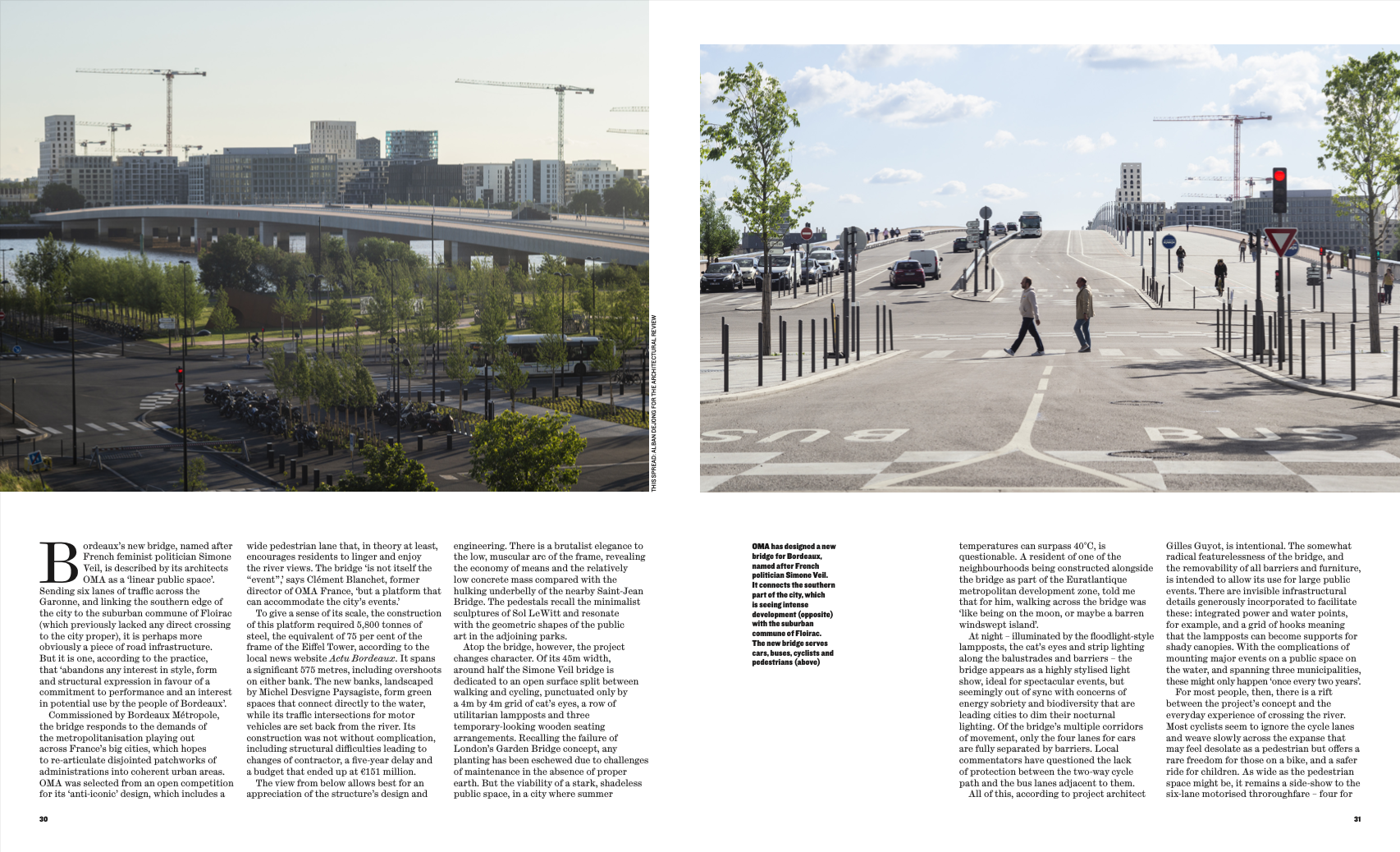
Bordeaux’s new bridge, named after French feminist politician Simone Veil, is described by its architects OMA as a ‘linear public space’. Sending six lanes of traffic across the Garonne, and linking the southern edge of the city to the suburban commune of Floirac (which previously lacked any direct crossing to the city proper), it is perhaps more obviously a piece of road infrastructure. But it is one, according to the practice, that ‘abandons any interest in style, form and structural expression in favour of a commitment to performance and an interest in potential use by the people of Bordeaux’. Commissioned by Bordeaux Métropole, the bridge responds to the demands of the metropolitanisation playing out across France’s big cities, which hopes to re-articulate disjointed patchworks of administrations into coherent urban areas. OMA was selected from an open competition for its ‘anti-iconic’ design, which includes a wide pedestrian lane that, in theory at least, encourages residents to linger and enjoy the river views. The bridge ‘is not itself the “event”, says Clément Blanchet, former director of OMA France, ‘but a platform that can accommodate the city’s events.’
The idealised ancient Athenian agora, where the public exchanged goods and news, and its Pnyx, where they listened to political and theatrical speech, seem to retain a hold over the imaginations of many architects, leading them to believe that the provision of open spaces and stepped seating will magick the performance of public life into being. But without the micro-infrastructures that invite use shade, ledges to sit on, the enclosure and acoustic resonance that make for a feeling of immersion – the Simone Veil bridge is an empty stage most of the time. Similarly, the parks’ sculptural offerings are mostly abandoned, their role in the project hard to read.
The experiment is ongoing, though. To OMA’s credit, they are continuing to work with Bordeaux Métropole to help it understand how to stage large-scale events. The design team is also responding to community concerns, testing safer demarcation for the cycle lanes and creating a handbook with the kinds of technical details any troupe needs to understand the workings of a theatre like who holds the keys to the electrical cupboard.
For now, at least during my two days observing life on the bridge, three young people pulling wheelies back and forth were the closest thing to the kind of performance OMA is aiming for. Perhaps their presence points to the potential of the project, once it has been adapted and added to, by skaters and BMXers, for example, with makeshift infrastructures for their sports. If we accept that a bridge is unlikely to replace shady parks and vibrant squares as a place of everyday public gathering, it could be the ideal place for modes of publicness based on movement and sport. Which raises the question, why not provide such infrastructure in the first place? ‘Programming can be the enemy of programme, Guyot responds. “The project has to be boring enough so the lively aspect of public life can emerge. It needs time’ What to do with the stage outside the performance? The more specified a space for performance is, the harder it is to welcome a multitude of other uses. But the bridge is not just a stage, it is also an infrastructure paid for by the public, whose mundane reality impacts on the lives of the thousands who will eventually walk, cycle and drive across it every day. The future of this experiment will depend on the creativity of the people of Bordeaux in imagining the role this new space might play in their lives. This does need time, but time may not be enough. The vision of grand public events might one day have to give way to more quotidian definitions of performance.
Images