Landscape for Learning
Excerpt from a review of the Institut Méditerraneén de la Ville et des Territoires, Marseille, by NP2F
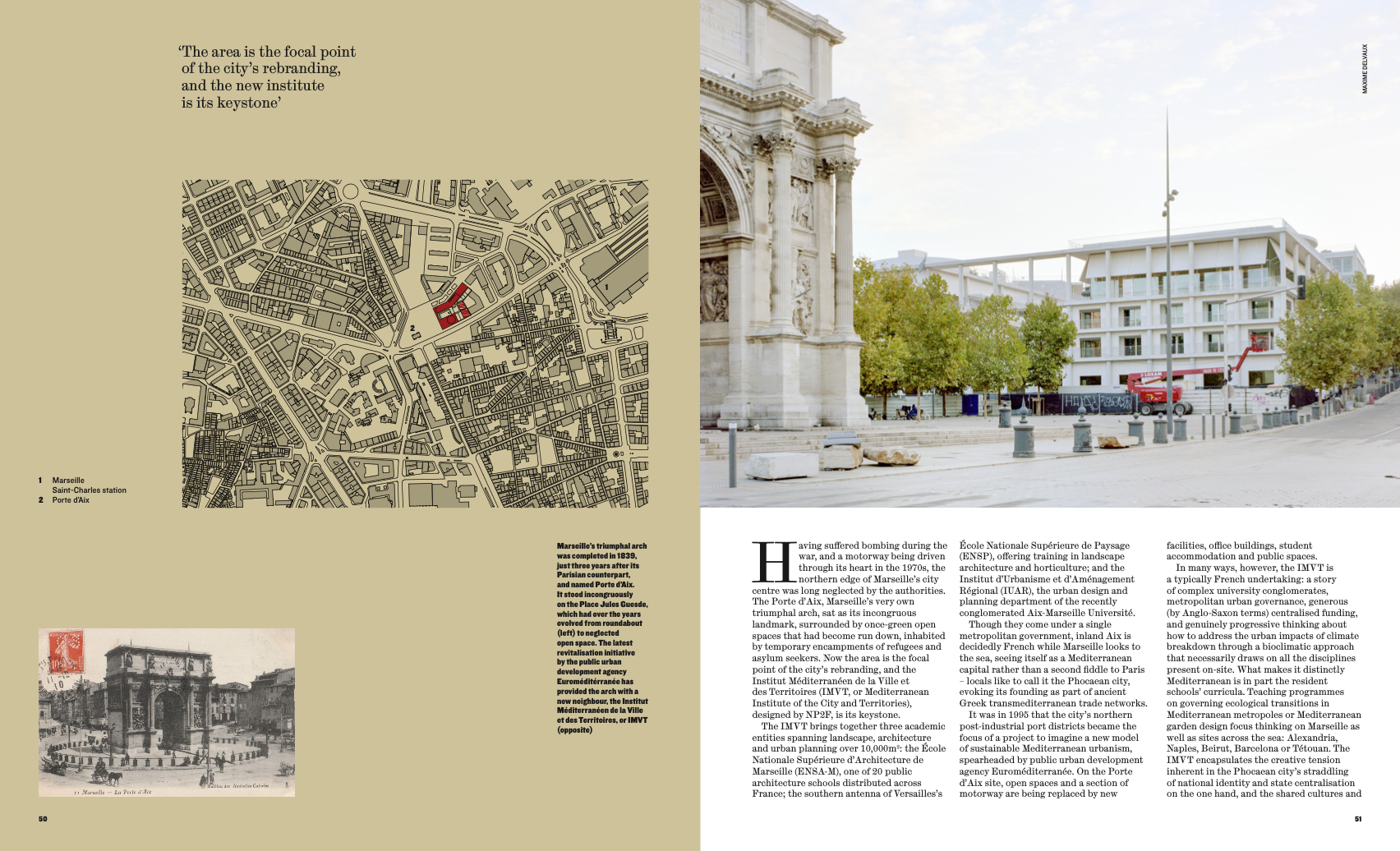
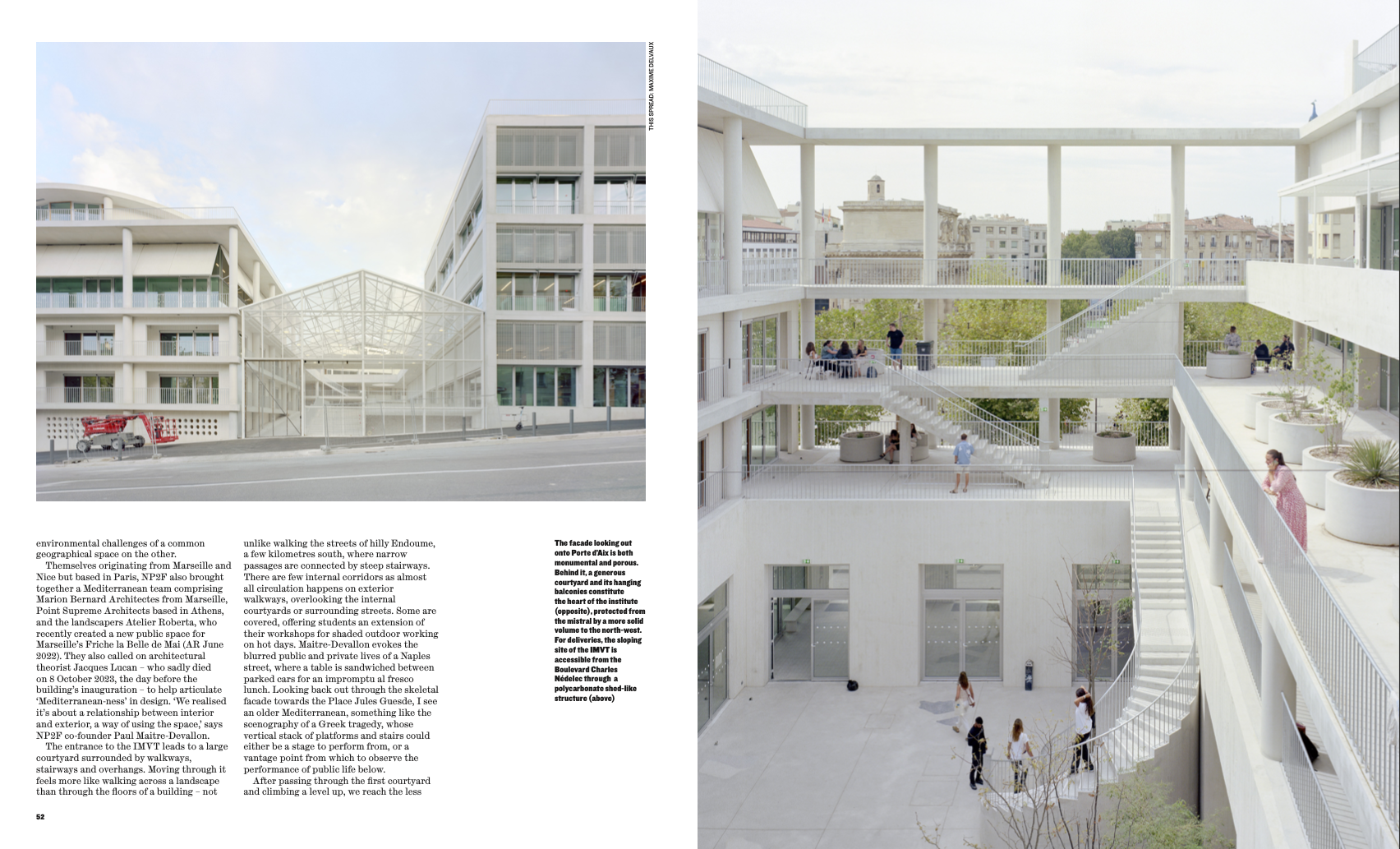
Having suffered bombing during the war and a motorway being driven through its heart in the 1970s, the northern edge of Marseille’s centre was long neglected by city authorities. The Porte d’Aix, Marseille’s very own triumphal arch imposed by Parisian powers in the 19th century, sat as its incongruous landmark, surrounded by once-green open spaces that had become dusty, inhabited by temporary encampments of refugees and asylum seekers. Now the area is the focal point of the city’s rebranding, with open spaces and a section of motorway being replaced by office buildings, student accommodation, and new public spaces. The Institut Méditerranéen de la Ville et des Territoires (IMVT, or Mediterranean Institute of Cities and Territories), designed by NP2F, is its keystone.
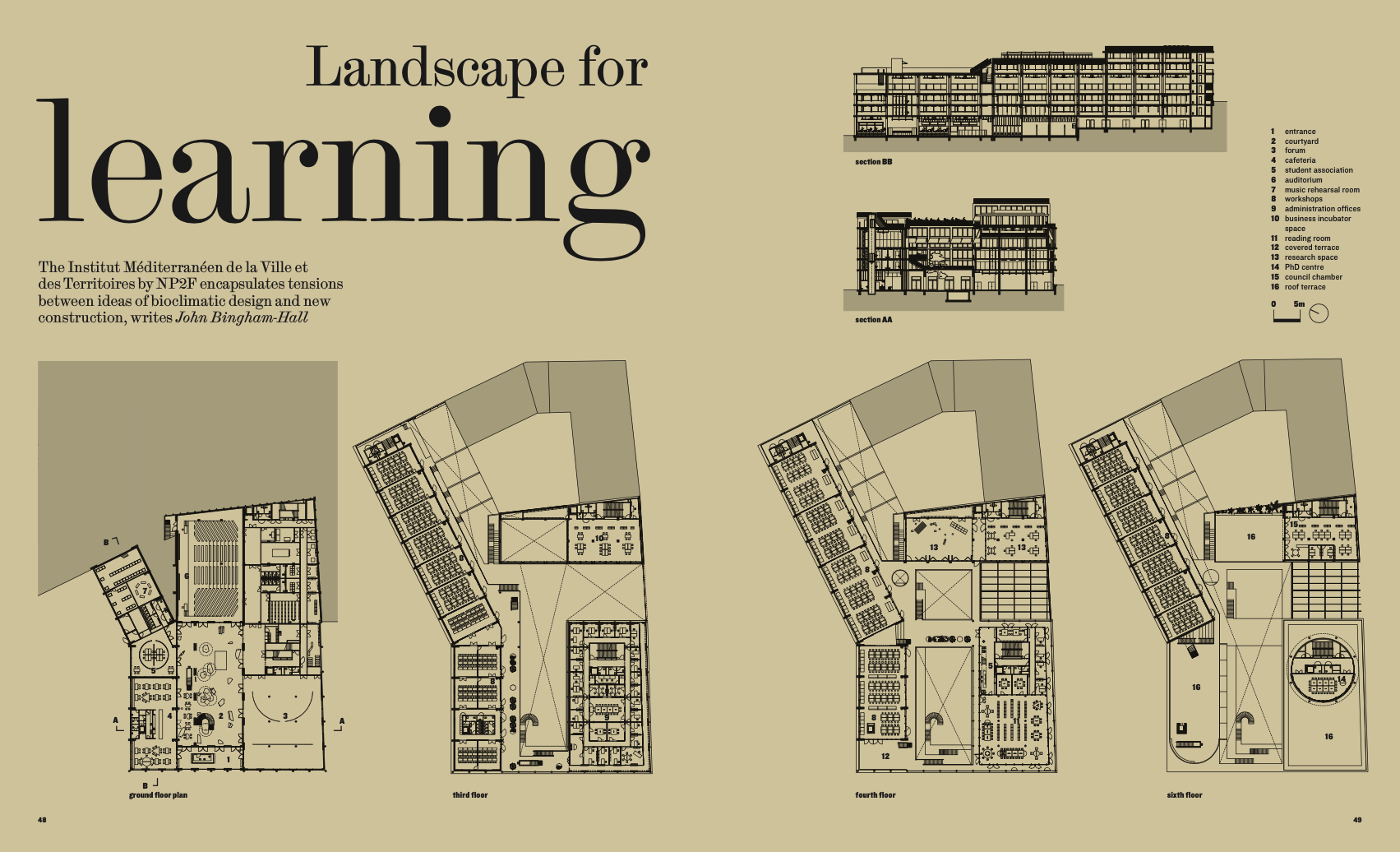
The IMVT brings together three academic entities spanning landscape, architecture and urban planning over 10,000m2: the École Nationale Supérieure d’Architecture de Marseille (ENSA-M), one of 20 public architecture schools distributed across France; the southern antenna of Versailles’ École Nationale Supérieure de Paysage (ENSP), offering training in landscape architecture and horticulture; and the Institut d’Urbanisme et d’Aménagement Régional (IUAR), the urban design and planning department of the recently-conglomerated Aix-Marseille Université. Though they come under a single metropolitan government, inland Aix is decidedly French while Marseille looks to the sea, seeing itself as a Mediterranean capital rather than a second fiddle to Paris. Locals like to call it the Phocaean city, evoking its founding as part of ancient Greek transmediterranean trade networks. It’s no surprise that this site was put forward by the Euroméditerranée public-private regeneration partnership, which aims to redevelop Marseille’s northern post-industrial port districts as a new model of sustainable Mediterranean urbanism.
In many ways, it is a typically French undertaking: a story of complex university conglomerates, metropolitan urban governance, generous (by Anglo-Saxon terms) centralised funding, and genuinely progressive thinking about how to address the urban impacts of climate breakdown through a bioclimatic approach that necessarily draws on all the disciplines present on-site. What makes it distinctly Mediterranean is in part the curricula of its resident schools. Teaching programmes on governing ecological transitions in Mediterranean metropoles or in Mediterranean garden design focus thinking on Marseillle as well as across the sea to Alexandria, Barcelona, Beirut, Naples or Tétouan. The IMVT encapsulates the creative tension inherent in the Phocean city’s straddling of national identity and state centralisation on the one hand, and the shared cultures and environmental challenges of a common geographical space on the other.
…
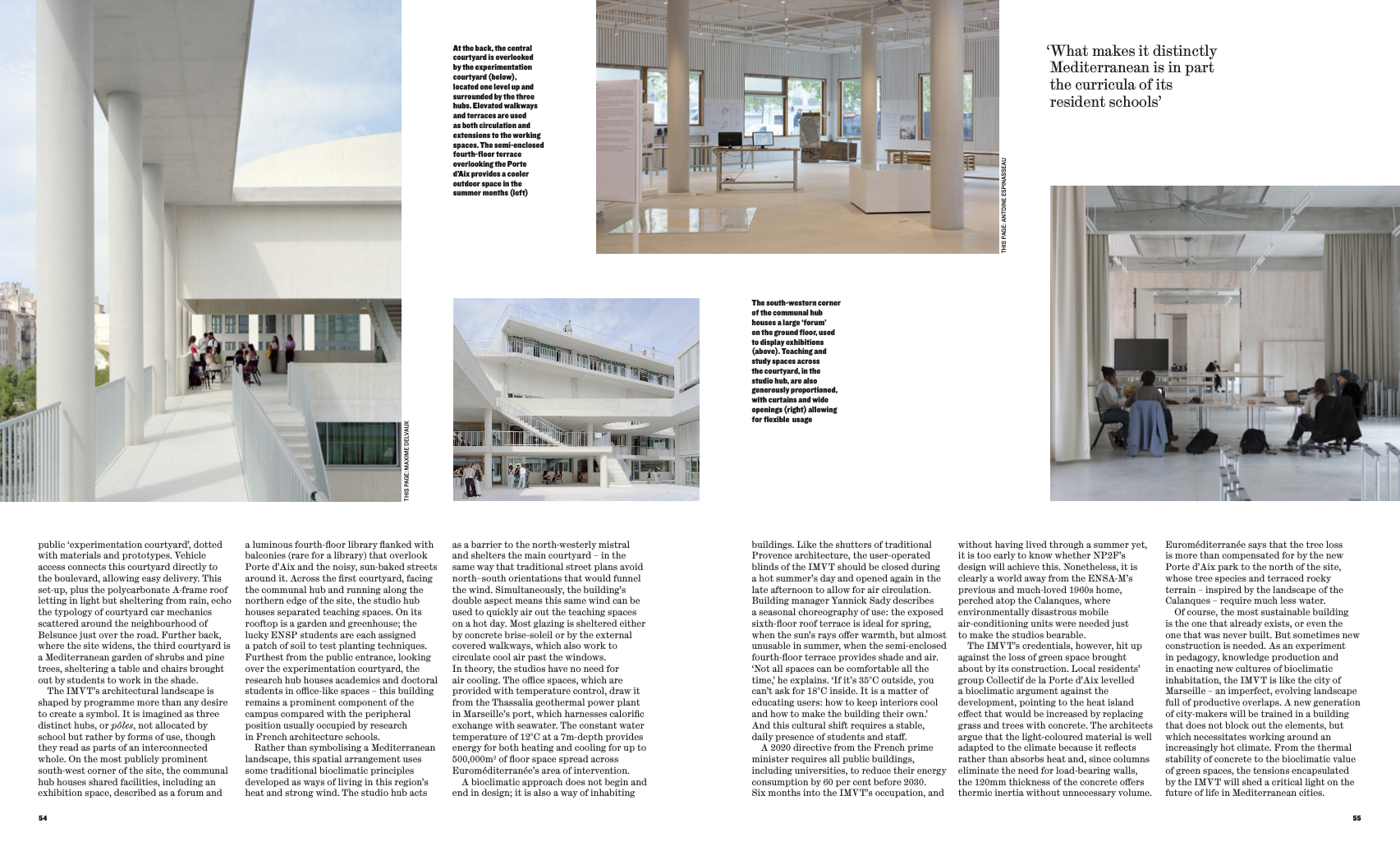
A bioclimatic approach does not begin and end in design; it is also a way of inhabiting buildings. Like the shutters of traditional Provence architecture, the IMVT’s user-operated blinds should be closed during the heat of a summer’s day and opened again in the late afternoon to allow for air circulation. Building manager Yannick Sady describes a seasonal choreography of use. The exposed sixth-floor roof terrace is ideal for spring, when the sun’s rays offer warmth, but almost unusable in the hot summer, when the semi-enclosed fourth-floor terrace provides shade and air. ‘You can’t expect all the spaces to be comfortable all the time,’ he explains. ‘If it’s 35ºC outside, you can’t ask for 18ºC inside. It’s a matter of educating users: how to keep interiors cool and how to make the building their own.’ Since the economics of higher education generate a more transient occupation, it comes down to the few staff with a stable daily presence to engender and impart this cultural shift.
A 2020 directive from the French prime minister requires all public buildings, including universities, to reduce their energy consumption by 60 per cent before 2030. Just six months into the IMVT’s occupation, and without having lived through a summer yet, it is too early to know whether NP2F’s design will achieve this. Nonetheless, it is clearly a world away from the ENSA-M’s previous and much-loved 1960s home, perched atop the Calanques, where environmentally-disastrous mobile air conditioning units were needed just to make the studios bearable. The IMVT’s credentials, however, hit up against the loss of green space brought about by its construction. Local residents’ group Collectif de la Porte d’Aix invoked a bioclimatic argument against the development, arguing that a heat island effect would be created by replacing grass and trees with concrete. The architects argue that the light-coloured material, created especially for the project rather than coming ‘off the shelf, is well adapted to the climate. It reflects rather than absorbs heat and, by avoiding load-bearing walls through the use of columns, it could be cast at the precise 120mm, offering thermic inertia without unnecessary volume. Euroméditerranée, the planning authority for the site, say that the tree loss is more than compensated for by the development of the new Porte d’Aix park to the north of the site, whose tree species and terraced rocky terrain – inspired by the landscape of the Calanques – require much less water.
Of course, the most sustainable building is the one that already exists, or even the one that was never built. But sometimes new construction is needed. As an experiment in pedagogy, knowledge production and in enacting new cultures of bioclimatic inhabitation, the IMVT is like the city of Marseille – an imperfect, evolving landscape full of productive overlaps. A new generation of city-makers will be trained in a building that does not block out the elements but necessitates working around the increasingly hot climate. From the thermal stability of concrete to the bioclimatic value of green spaces, the tensions encapsulated by the IMVT will shed a critical light on the future of life in Mediterranean cities.
Images