Cultural Field
Excerpt of a review of a new public space at the Friche Belle de Mai, Marseille, by Kristell Filotico and Atelier Roberta
On the raised rail line bordering the collection of buildings that make up La Friche la Belle de Mai cultural centre, trains screech and heave into Marseille’s Gare St Charles. Above the rails, the tiled roofs of houses and small apartment blocks pile chaotically on top of one another as they cling to Marseille’s steep, rocky terrain. The environment is dense, mineral, infrastructural. This is the neighbourhood of Belle de Mai that gives the cultural centre its name, and is decidedly ‘the wrong side of the tracks’. The train station is a mid-way point between the infamous quartiers nords – longstanding working class neighbourhoods connected to the port – and the wealthy gated communities and suburbs lining the beaches to the south of the rapidly-gentrifying city centre, acting as a meeting point between these worlds.
Visitors to La Friche are met with a cornucopian vision, evocative of Joan Littlewood and Cedric Price’s ‘Fun Palace’ ideal. Busy basketball courts and a skatepark line one side, a sunken pit designed for practising dance routines another. A dizzying array of ramps and stairways lead away to other levels of the open-sided concrete factory building. La Friche la Belle de Mai occupies part of the old SEITA (the French government tobacco company) factory that, from 1860, developed a vast industrial site along the rail lines. Its closure in 1990 caused the loss of more than a thousand jobs, exacerbating economic troubles in what was already the poorest district in the centre of Marseille. Workers’ protests, against the transfer of the site’s industrial activities to the neighbouring town of Vitrolles, were still ongoing when Marseille’s city hall took on the site for a nominal lease, with a view to a new cultural future. Its numerous buildings now house the city’s main film studios, the storage and conservation centre for its main museum, and the municipal archives, with La Friche the most emblematic of the new cultural infrastructures to be installed on the site.
But many of these are closed to access or lead to working spaces, meaning the centre is not quite the open invitation for play and discovery imagined by Littlewood and Price. Initiated in 1992 by the municipality and the theatre company Système Friche Theatre, its cultural transformation was formalised and made permanent in 1995 under a plan led by the architect Jean Nouvel, though as president of the centre’s non-profit management organisation rather than as a designer. This plan envisioned La Friche as a driver of urban change, and as an urban experiment in itself, making it an early example of the model for hybrid creative production and public cultural spaces that has come to dominate France’s artistic scene. Known as tiers lieux (meaning ‘third spaces’), such projects have grown from opportunistic responses to disused spaces, to a social movement, to a veritable industry, with an estimated 800 across the country, characterising culture-led regeneration in a context of shrinking public funding.
…
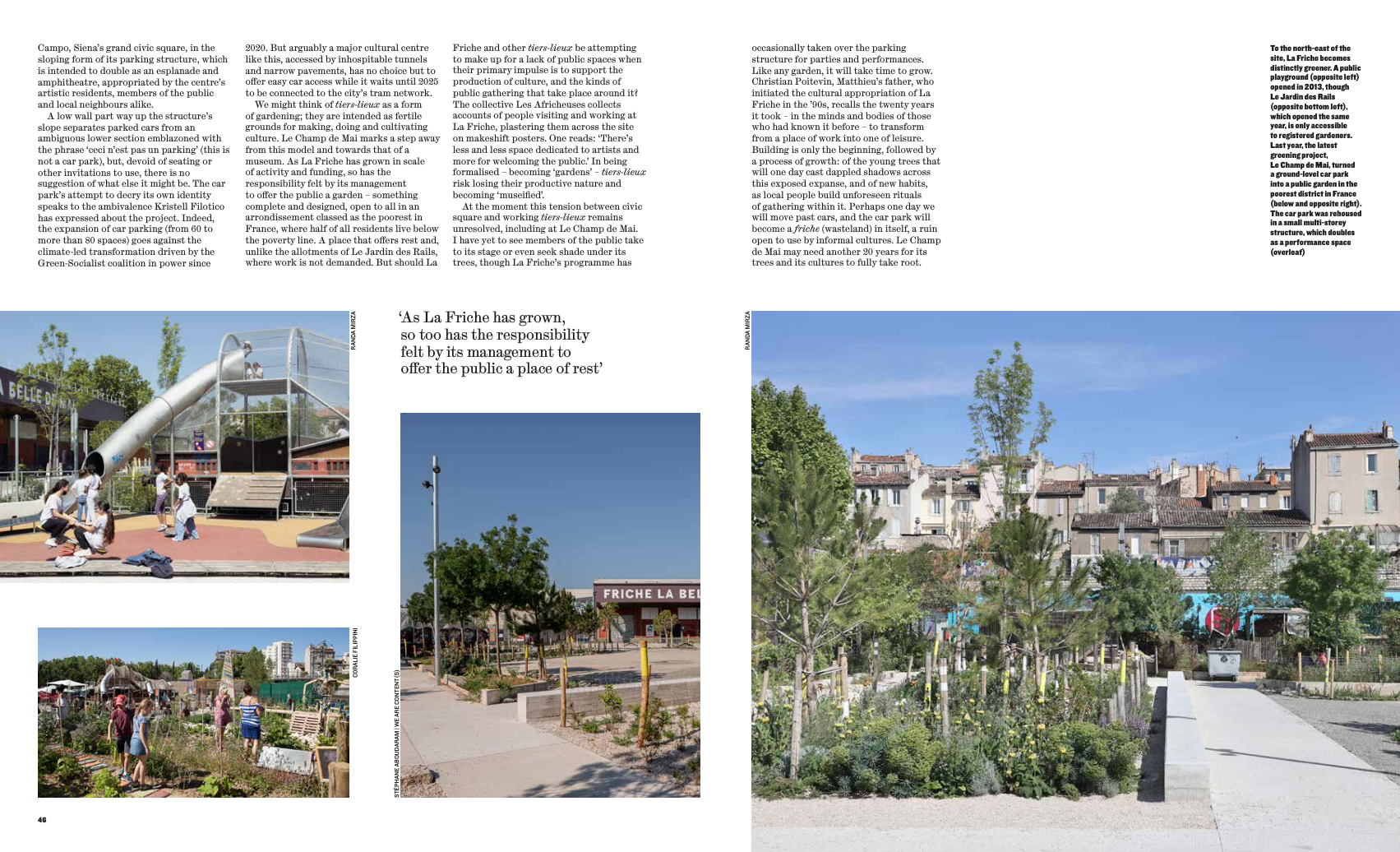
We might think of tiers lieux themselves like gardening. They are intended as fertile grounds for making, doing, cultivating culture. Le Champ de Mai marks a step away from this model and towards that of a museum. As La Friche has grown in scale of activity and funding, so has the responsibility felt by its management to offer the public a garden – something complete and designed, open to all in an arrondissement classed as the poorest in France, and where half of residents live below the poverty line. A place in which rest is offered, and unlike the Jardin des Rails, where work is not demanded. But should La Friche and other tiers lieux be attempting to make up for a lack of public spaces, when their primary impulsion is to support the production of culture, and the kinds of public gathering that take place around it? The collective Les Africheuses gathers accounts of people visiting and working at La Friche, plastering them across the site on makeshift posters. One reads: ‘there’s less and less space dedicated to artists and more for welcoming the public’. In formalising – becoming ‘gardens’ – tiers lieux risk losing their productive nature and becoming ‘museified’.
Tiers lieux provide vital infrastructures for culture, but their co-option and professionalisation brings conflict between the divergent aims of their operators, their users, and their funders. La Friche is a major landmark for visitors to Marseille as well as a centre of gravity for its local cultural scene – though few of these visitors venture beyond La Friche into the streets of Belle de Mai, meaning the neighbourhood has so far remained untouched by the natural wine bars and new wave coffee shops that are proliferating to the south of the rail lines.
In Le Champ de Mai, Filotico has restrained from writing over La Friche’s industrial past, but also its working present. At the moment this tension between civic square and working tiers lieu remains unresolved. I have yet to see members of the public take to its stage or seek shade under its trees, though La Friche’s programme has occasionally taken over the parking structure for parties and performances. Like any garden, it will take time to grow. Christian Poitevin, who initiated the cultural appropriation of La Friche, recalls the twenty years it took – in the minds and bodies of those had known it before – to transform from a place of work to one of leisure. Building is only the beginning, followed by a process of growth: of the young trees that will one day cast dappled shadow across this exposed expanse, and of new habits, as local people build unforeseen rituals of gathering within it. Perhaps one day we will move past cars, and the car park will become a friche (‘wasteland’) in itself, a ruin open to use by informal cultures. Le Champ de Mai may need another twenty years for its trees and its cultures to become fully rooted.
Images